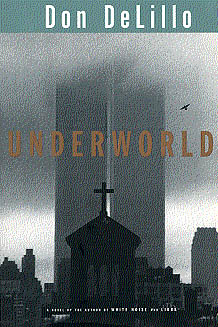
Starting in late fall of 1996, the buzz began circulating on DeLillo's long novel Underworld. This page lists each known report on the book leading up to its publication and beyond (most recent on top).
Page revised in Nov. 2025 to include many review excerpts, links where found, and roughly chronological groupings.
March, 2024: Underworld has been included in The Atlantic's Great American Novels listing - a total of 136 titles first published in the U.S. in the last 100 years.
January, 2024: Underworld has been included in Simon & Schuster 100 on the occasion of their 100th anniversary.
August, 2015: The Picador Classic edition of Underworld included an introduction by novelist Rachel Kushner, and it was published online at The Guardian with title "Don DeLillo's Underworld - still hits a home run". Here's a piece:
Some authors go for sweep, others for sentences, and yet Underworld is both. Sentence by sentence, it may have the highest density of great sentences of all DeLillo’s novels, at two or three times as long as the rest. How did he sustain it? I have no idea, and the how is not for me to wonder. The book exists. It raises the bar on what can be done.
August 3, 2015: The Guardian included Underworld in their list of 100 best novels. Robert McCrum wrote the entry for DeLillo's novel. Here's a piece:
Underworld is the work of a writer wired into contemporary America from the ground up, spookily attuned to the weird vibrations of popular culture and the buzz of everyday, ordinary conversations on bus and subway. According to Joyce Carol Oates, he is "a man of frightening perception", an all-American writer who sees and hears his country like no other. This ambitious, massive (832pp) and visionary edifice certainly looks like a masterpiece; widely acclaimed by critics on first appearance, it is often chosen by lists like this.
July 15, 2011: The New York Times asked their writers for a 'single summer pleasure' and book reviewer Michiko Kakutani contributed her pick of Underworld in 'A Prescient Novel Retains Its Power'. Here's how she begins:
A decade after 9/11, it's worth rereading Don DeLillo's 1997 masterpiece, "Underworld," to appreciate how uncannily the author not only captured the surreal weirdness of life in the second half of the 20th century but also anticipated America's lurch into the terror and exigencies of the new millennium.
May, 2006: The New York Times conducted a survey of 125 writers to find their choice for the 'Best Work of American Fiction in the Last 25 Years' and Underworld came in number two with 11 votes (behind Toni Morrison's Beloved). For more on this, see the item under Odds & Ends.
August 21, 2003: Several pieces on Underworld that have appeared in The Guardian.
The Guardian "How time flies" by John Mullan, a short piece on the chronology of Underworld, August 16, 2003.
In matters of character and personal destiny, the chronological complexity is often intriguing. Yet DeLillo does not always seem to recognise the potential of his own narrative method. He is most interested in the historical utility of his narrative structure - not in human individuality but in the "underground network" of a society.
The Guardian "Moving Pictures" by John Mullan, a short piece on the cinematic qualities of Underworld, August 9, 2003.
Private desires, radio broadcasts, parental refrains and, somewhere nearby, loudspeaker warnings to a crowd: all are simply interleaved. This jumpy narrative is best suited to juxtaposition and incongruity - to representing differences. We take it on trust that the fragments belong together. Klara searches Unterwelt for its "politics of montage" and DeLillo expects a good deal in requiring the same of his reader.
The Guardian "And then he ate the apple..." by John Mullan, a short piece on the language of Underworld, August 2, 2003.
Underworld goes further. It likes verbless sentences and descriptions that merely collect things. While concerned with hidden connections and beguiling conspiracy theories, at eye level it is disconnected. Parataxis performs the disconnection, catching at fragments. No wonder that, for DeLillo's characters, paranoia is such a solace.
The Guardian "Pass the parcel" by John Mullan, a short piece on Underworld as a 'novel of circulation,' July 26, 2003.
The idea of fitting a society into a novel by following an object is an old one. The device was popular in the 18th century, especially after Francis Coventry's satirical novel Pompey the Little (1751). The title of this anatomy of Georgian absurdities is the name of the lapdog whose fortunes Coventry describes. Each owner is a representative character (a fop, a Methodist, a prostitute, and so on). Critics sometimes call such a narrative a "novel of circulation". One of the bestselling novels of the 18th century was another such: Charles Johnstone's Chrysal; or, The Adventures of a Guinea (1760-5), which follows a gold coin through the hands of the great, the vicious and the foolish.
1998 baseball follow-ups on Underworld:
San Francisco Chronicle ran "Following the Bouncing Ball" by David Kipen, on Sept. 27, 1998. As the baseball season comes to an end close, Kipen delves into Underworld and a nice companion baseball story writen by John O'Hara in 1939.
The New York Times ran a short interview with DeLillo by David Firestone, entitled (and online): "A Talk With Don DeLillo: Two Shots Heard 'Round the World". Some talk on baseball following Mark McGuire breaking Roger Maris's single season record on Sept. 8.
Transatlantic presented an interview in German by Ruth Bender entitled (probably mistakenly) "Basketball und die Bombe" in late 1998, I believe.
Q: Where were you when Bobby Thomson hit the legendary home run in the baseball game in October 1951?
A: I was at the dentist in the Bronx. I was 13 or 14, the radio was on, and when the home run hit, the whole office erupted, shouting and clapping. I was a Yankee fan back then; that is, I wasn't that emotionally involved. But I do remember that at that moment, car horns started blaring, people were running out of their houses.
Der Standard, Austria
ran an interview with Don DeLillo and a short review of "Underworld" in its "Album" weekend supplement of its issue of Oct. 30th, 1998. (thanks to Christian Rott).
The interview with DeLillo is the supplement's title story: "Sprache ist der einzige Fluchtweg" (translated: "Language is the only escape route") by interviewer Peter Körte.
On the back of the same page there's a short book review: 'Unter weissgeblutetem Himmel / US-Geschichte(n) aus der Vogelperspektive: "Unterwelt" '(translated: Under a sky bleeded white / A bird's-eye view of US history (stories)).
Q: It's no secret that you're not particularly fond of book tours and promotional trips. You've probably talked more about Underworld by now than about any other novel before it. Does this change your relationship with the book, or does it risk becoming part of the media's "empty, white space"?
Don DeLillo: What happens is this: you create a second narrative, running parallel to the text itself, simply to explain something that, during the time I was writing the book, was largely based on intuition. Suddenly you have to talk about it as if you knew what you were doing back then, even though you were just being propelled forward. In a way, talking can be clarifying. When I was writing Underworld, I certainly didn't say to myself, "This is a book about conflict," but today I can agree with myself that it is. You live inside your characters, and it's important to be clear about the structure, the architecture of the book. Then, as you approach the end, you begin, very, very slowly, to step out of the book and try to grasp it as a somewhat coherent interpretation of the world.
(translation via Google)
Neue Zürcher Zeitung (NZZ), Zurich, "Aus der Unter- in die Oberwelt - Ein Gespräch mit Don DeLillo" by Armin von Büchau, 14. November 1998.
Neue Zürcher Zeitung (NZZ), Zurich, "Von der Fleischkathedrale ins Mutantenmuseum" by Angela Schader, 10. October 1998, page 67.
The German edition of Underworld came out in October, 1998. Here are some articles from the German press:
Marabo, Müll vereint dei Menschen" review by Anne Ullenboom, December 1998.
Garbage. All garbage. Waste, scrap, remnants. The mountain of things everyone has but no one wants keeps growing. The empty shell left behind of what was truly important. Don't think about it, just get rid of it.Throw it away. The American writer Don DeLillo has now dedicated an entire novel to this sordid subject: Underworlda>. 966 pages to throw away. Garbage in its most beautiful form.
(translation via Google)
Die Zeit, Hamburg, "Mr. Paranoia" a (rather contentious) interview by Jörg Burger, 8. October 1998, ZEIT magazin. English translation by Tilo Zimmermann.
Zeit: Now you sound like one of those weirdos from the X-Files.
DeLillo: I am merely employing cultural trends surrounding me. It is impossible to write a novel about America in the Cold War without using an element of paranoia and conspiracy. Today militias are holing up in the South of the U.S., because they are afraid of UN-troops taking over the government. Members of a cult commit collective suicide because they believe a comet is coming to reclaim their souls. Writers do not make this up. It just happens.
Berliner Morgenpost, Berlin, "Eine Welt, deren Werte nicht mehr die alten sind" review by Maria Moss, 7. October 1998, Literaturbeilage.
Süddeutsche Zeitung (SZ), Munich, "Baseball, Bombe und Müll im nuklearen Zeitalter" review by Eberhard Falcke, 7. October 1998.
Süddeutsche Zeitung "Das Leben is ein Roman" review by Michael Althen in German (includes a reference to the page as well) (Nov. 22, 1997).
In Underworld wird alles durch vom Schatten der Atomobombe zusammengehalten, der sich über alles Leben in unserer Zeit gelegt habe - unsichtbar, aber spürbar. Google translation: In Underworld, everything is held together by the shadow of the atomic bomb, which has fallen over all life in our time - invisibly, but noticeably.
die tageszeitung (taz), Berlin, "Ball und Bombe - Nostra Aetate" by Erhard Schütz, 7. October 1998, page 7 Literataz. Incidentally, this article mentions this website:
"Auf der Website http://haas.berkeley.edu/gardner/delillo.html findet man ziemlich alles, was man immer schon zu DeLillo wissen wollte. DeLillo ist kamerascheu. [...] Alles weitere auf der Website."
Which translates to "On the website http://haas.berkeley.edu/gardner/delillo.html you can find pretty much everything you always wanted to know about DeLillo. DeLillo is reclusive. [...] All further details on the website."
Frankfurter Rundschau review by Peter Körte entitled "Der Müll, die Bombe und der Homerun" (Monday, Oct. 6, 1997, pg. 7).
Der Tagesspiegel, Berlin, "Die Flugbahn des Baseballs" by Jörg Drews, 2. October 1998, Literaturspiegel.
By mid-1998 the first wave of Underworld critical re-appraisals began.
Alt-X, Electronic Book Review ran quite an interesting review entitled "Lessons in Latent History" by Steffen Hantke in #7, Summer 1998.
Critics who think of DeLillo as coming into his own with his later novels will probably see the recycling of ideas from his earlier work as a self-conscious elaboration of the double theme of garbage and recycling. The whole of Underworld is prefigured by DeLillo's 1973 novel Great Jones Street, which features a scene in which we get to overhear parts of a party conversation. One of the nameless speakers identifies himself as The Morehouse Professor of Latent History at the Osmond Institute ("But I don't occupy the Morehouse Chair. I occupy the Houseman Chair."). Latent History, as DeLillo calls it, "deals with events that almost took place, events that definitely took place but remained unseen and unremarked on, like the action of bacteria or the rising and falling of mountain ranges, and events that probably took place but were definitely not chronicled."
Boston Review "Visions of the American Berserk" by Paul Gediman takes a look at Underworld and Philip Roth's American Pastoral, 1998.
In it's (sic) ambition, Underworld belongs with such icons of excess as Gravity's Rainbow and Ulysses. Yet it has an integrity of voice and an accessibility that those behemoths lack. Despite the wide range of its attentions and its nonlinear trajectory, it is not at all ungainly. It is a monumental feat of imagination that succeeds, to a remarkable extent, in making us see much of the last half of the American century at once.
DoubleTake magazine has an article entitled "Don DeLillo's Brave New World" by Sven Birkerts in the the Fall 1998 issue (Vol. 4, No. 14), p. 126.
Raritan "Afterthoughts on Don DeLillo's Underworld" by Tony Tanner, volume XVII:4, Spring 1998. A generally negative rethinking of Underworld.
But, having pretty much given up on people and plots (conventional ones, anyway), DeLillo in Underworld is totally reliant on history from the opening events of 1951, onwards (he has “turned to the news”). By all means be adversarial to the so-called official versions of the times—as Melville said in Billy Budd, such histories have a way of “considerately” “shading off” any discreditable events into “the historical background.” But it seems odd to write of “the brutal confinements of history” per se, particularly when your subject is, manifestly, Cold War America.
World Socialist Web Site published "The serious artist and the Cold War" by David Walsh on 3 November, 1998.
Underworld is a disquieting novel. It makes conservative critics nervous olor good reason. Whether or not DeLillo has succeeded in working out the psychology of the Cold War era, an impossible task for a single work, he has certainly registered some of that era's pervasive anxiety and unhappiness and alienation, and given it human form. "Didn't life take an unreal turn at some point?" someone asks. DeLillo describes a society living in a kind of suspended animation, going through the motions. One senses that no real human difficulty can be confronted. Postwar America is a "success story" in which people busy themselves with everything except what's destroying them. Repression takes the form of this evasion of an authentic inner life.The World & I "Apocalypse, Then and Now" by Thomas Deignan (March, 1998).
... what may be the most wonderful section of Underworld: DeLillo's extended tour through the 1950s Bronx of his youth. Largely Italian (though Nick's mother is Irish Catholic), DeLillo conveys the street aromas and rhythms of the tight-knit neighborhood, as well as the suffocating labor, racial antagonisms, and intense religiosity—all without sentimentality or righteous moralizing.
LM "The aftermath of paranoia" by Henry Joy McCracken (Issue 109, April 1998).
AGNI "Plumbing the Underworld" a long review of Underworld by George de Man (Issue 47, 1998).
Causes and effects are a shambles; maybe that is why from 1951 the novel flash-forwards to 1992 and begins its crooked, disintegrating path into the past and back again. The political iconography of the Cold War—your government has photographed Death, and it looks like a mushroom—lives on in the national subconscious in a way that a baseball game, with its crude relics, cannot: as an interdicted part of ourselves.
In May 1998 DeLillo read in Amsterdam:
NRC in Holland ran an interview with DeLillo in Dutch on May 29, 1998, which can be found in the Wayback Machine as "Conversation with American writer Don DeLillo" by Bas Heijne.
Popular culture is so dominant in the United States that it absorbs virtually everything, even something as terrifying as the atomic bomb. In a peculiar way, something threatening is absorbed and neutralized, and then the culture can focus on consumerism again. Charles Manson receives royalties for T-shirts featuring his portrait. In my novel, I have the comedian Lenny Bruce perform, with long monologues about the Cuban Missile Crisis, because I believe the nuclear threat gave birth to sick humor. Of course, Bruce is a character here; the novel is primarily about personal obsessions and desires, but on another level, in Underworld I tried to show as much as possible of the bomb's influence on American culture.
(translation via Google)
The book was officially published in the UK in January 1998. DeLillo made an appearance in London on January 15. See the Events page for details, and this detailed report by Amy Friedman, who attended.
Many pieces in the UK press:
New Statesman "Don DeLillo: the essential dinner-party guide" (Jan 23, 1998, p. 47). A mock Q&A about DeLillo and Underworld. "Everyone's talking about Don DeLillo. Why? His novel Underworld has just been published. It establishes him as the commanding presence of contemporary American fiction, Philip Roth and Thomas Pynchon being his only serious rivals."
New Statesman "The uses of junk" review by Michael Mewshaw (Jan 2, 1998, p. 52).
Now, it seems, he has decided to deconstruct his oeuvre, to atomise and then reassemble it. In effect, he has turned his own books into debris - breaking down and recombining the hobby horses, hilarious riffs, high-plumed styles, low-life scenes, linguistic experiments and pungent aperçus of his earlier work - and crammed it all between the covers of Underworld, another noble attempt to hit the long ball and lay down a marker for those who follow its soaring trajectory.
Three articles from the London Evening Standard:
"Underworld" a review by Allison Pearson (Jan. 12, 1998);
"Up from the Underworld" a DeLillo profile by Andrew Billen (Jan. 28, 1998); and
"Underworld: over-hyped and over here" an essay by Christopher Hitchens (Dec. 11, 1997).
London Review of Books, Vol 20 No 3, Feb 5 1998, has a review of Underworld by Michael Wood on page 3 called "Post-Paranoid".
Underworld, like Thomas Pynchon's Mason & Dixon, is in this sense a post-paranoid novel. When one of DeLillo's characters thinks of 'the paranoid élite', we are meant to catch the friendly irony, the flicker of nostalgia. These are people who believe that the first moonwalk was 'staged on a ranch outside Las Vegas', and then transmitted on television as if from space.
Independent on Jan. 4, 1998 ran a review by Blake Morrison.
No, more important to the book's momentum than any of these is DeLillo's eye for details that seem to sum up a whole decade (like Jell-O, which triggers a brilliant pastiche of Middle America, circa 1957) or which allow him to connect the seemingly unconnectable: it's while going out to buy a packet of Lucky Strikes that Nick's father disappears, and lucky strikes, or the world's avoidance of the ultimate unlucky strike, are what Underworld is about.
The Telegraph ran a review of Underworld entitled "The country where history is more inventive than fiction" by Christophey Bigsby on Jan. 3, 1998.
Underworld has its flaws - stylistic lurches from naturalistic riffs to surreal poetics, an over-emphasis on the arterial sludge of a fading civilisation - but it stands as some kind of implacable monument at the end of our century, a Babel tower of conflicting languages but shared endeavour.
The Irish Times "Pitched into the future" a review
by Eileen Battersby on January 8, 1998.
DeLillo's The Names is a masterwork because it is about everything and nothing, is set everywhere and nowhere. Underworld achieves a similar artistic cohesion through its attention to specifics while also remaining random. DeLillo looks at the big issues of consumerism, weaponry, ethnic nuance, waste disposal, national paranoia - "You have to understand that all through the 1950s people stayed indoors. We only went outside to drive our cars ... Because a threat was hanging in the air" - while also exploring the minutiae of ordinary, small lives. Stylish, humane, daring, this dazzling performance possesses wisdom and integrity to match its awesome technique, style and scale.
The Telegraph ran an interview entitled "They're all out to get him" by Mick Brown on Jan 10, 1998. He met with DeLillo in Manhattan for a wide-ranging conversation. Here's a bit from DeLillo:
The neighborhood was really all I knew for a long time. I remember when I was 17, maybe 18, I was working in a playground in the Bronx and an old friend came by and said 'I think we should get out of the city for the summer.'He'd heard about a summer camp in the Adirondack mountains where we could get a job as counsellors. And this was the first time I'd ever realised that such a thing existed - a camp where boys and girls went to spend their summers. It was basically inconceivable. That's how narrow my life was. We went to the camp, and when I returned after two months in the mountains it occurred to me for the first time that I lived in a part of the world that was quite ugly physically; the buildings, the streets looked completely different to me. It has never occurred to me to take this perspective. How could I?
The Irish Times featured a DeLillo interview entitled "And quiet writes the Don" by Fintan O'Toole on January 10, 1998. Opens by saying that Don had lunch in Greenwich Village with Bobby Thomson. (Thanks to Seamus Heaney)
The Cold War in America is utterly different from the Cold War in, say, Germany. Here, it's inevitably associated not just with danger but with popular culture. You think of the mutant monster movies and then you think of Cadillacs and tail-fins and Jayne Mansfield.This all becomes a Cold War reality rather than just a pop art. There's a curious combination of associations, so that the design of a vacuum cleaner makes you think of a Sputnik, because in fact vacuum cleaners were designed to look like space satellites. That's what happens in this culture. The consumer impulse becomes associated with whatever reality is informing our psychology, even a deadly dangerous reality.
The Guardian "Everything under the bomb" a meaty interview by Richard Williams (Jan. 10, 1998).
The original piece took a year to write, and the decision to publish it in Harper's appears to be something of a mystery to him now. "I'm not sure what impelled me. Maybe I wanted some public encouragement. I've certainly never done that before. I didn't publish it in the spirit in which one publishes extracts from an already-finished novel, which is a form of publicity. It's not as though I was convinced it represented the beginning and the end of this experience. I must have felt that there was some hope for a larger work." After its appearance in the magazine, he received offers from several quarters to publish as a short book, as it stood. "That's when I faced the truth that I would definitely be moving it forward."
The Herald (Scotland) "The echo in an explosion" interview by Pat Kane on 18 Jan. 1998.
About the end of the novel and 'cyberspace': DeLillo: This is a Cold War technology that is about connection, rather than conflict. The last word of the novel, just a two-dimensional pulse on a computer screen, is Peace. And I mean that, again, to be completely unambiguous. In a novel which is so steeped in conflict - between men and women, races, classes, where there are baseball matches, chess matches, children's games - I wanted a yearning for peace to be at the end.
The Observer "The course of true life" review by William Boyd (Jan. 11, 1998).
The structure holds, massily, four-square, magnificently. Another cause for unequivocal acclaim is DeLillo's marvellous prose - a deft and fluent instrument that performs all tasks demanded of it, from heavily wrought lyricism - "the musky coconut balm and the adolescent savour of heat and beach and an undermemory of seawater rush, salt scour in the eyes and the nose" - to unadorned plainness - "They sat there waiting and they talked." DeLillo is a realistic novelist and his work is rooted in contemporary life in all its ugliness and grandeur, its rawness and beauty.
The Observer reprinted the DeLillo essay "The Power of History" on January 4, 1998.
The Guardian "Books of discrimination" short review by Richard Williams (Jan. 8, 1998).
The feeble leftism that DeLillo so smartly burlesqued in White Noise, he now appears to revere. It is noticeable that, almost without fail, whenever DeLillo writes about conspiracies and secrets and American paranoias, his language, usually exact, becomes a thick scrabble, becomes sentimental and windy. There is a pompousness in this novel that suggests not so much epic ambition as epic confusion.
The Sunday Times "Out to get us" by Michael Dibdin (Jan. 4, 1998).
DeLillo is a virtuoso at "bits", at jazzy riffs. The problem is that he wants them to add up to more than the sum of their parts, and that to do so he forces them into the very patterns they are supposed to evoke. Underworld is not so much constructed as constricted, and with a finale which sounds as false as an orgasm of C major chords tacked on to an atonal work.
Times Literary Supplement "Hitting the Home Run" by Paul Quinn (December 26, 1997, p. 21).
The criticisms Underworld has received so far, both in the United States and Britain, have tended to focus on the fact that we don't get to "know" Nick, the way we get to know some of the incidental characters. But this is DeLillo's politics and aesthetics — to problematize the centre and how it gets constructed, and to open the periphery up. No one currently writing has peripheral vision more penetrating than DeLillo's.
Additional reviews from Nov/Dec 1997:
Ink Magazine ran a review by K.P. Knight in Issue 5, January 1998. Online at Wayback Machine.And yet I don't love this novel. The reason is not, as some have said, because it's too "political." I have no problem with DeLillo's cultural vision -- it's neither too dark nor excitingly radical to me. In fact, his approach is reminiscent of the explicit Beat litanies of the '50s and '60s, though a lot less angry. I think it's simply that I couldn't care much about the people or their lives and didn't get caught up, transported, as one yearns to do in fiction. The main character, Nick Shay, who appears in both first and third person, is not sympathetic -- I view him from a certain distance. Many other interesting folks populate these pages, notably Cotter Martin, the black kid who caught the ball, Sister Edgar, and Klara Sax (changed from Sachs when she became a famous artist), but none of them gets under my skin.
Sydney Morning Herald ran two reviews: "DeLillo Hits a Homer" by Alan Attwood (Oct. 25, 1997) and "Cold War and Peace" (Nov. 22, 1997).
The Australian Way (Qantas magazine) review by Michelle Griffin (January, 1998, p. 88).
Think of Underworld as some vast and perfectly written web site dedicated to the Cold War and its effect of popular culture, with hundreds of interlinked characters and ideas: baseball, Lenny Bruce, student riots, J. Edgar Hoover, conspiracy theories, waste management, chess, sculpture, nuns in the Bronx, swingers and clubs in the desert.
Commonweal "DeLillo's surrogate believers" review by Paul Elie (Nov. 7, 1997, pp. 19-22).
New Leader "Stalking the elusive zeitgeist" review by Ben Downing (Sept. 22, 1997, pp. 17-18). Not a favorable review; "If this novel had been written by a hack, I would be tempted maliciously to dub it 'Undercooked' or 'Blunderworld' and to draw snide analogies with Waterworld."
National Review "The Los Angeles of Novels" review by James Gardner (no relation!) (Nov. 24, 1997, pp. 60-61). Refers to the novel throughout as 'Underground.' "A massive post-industrial sprawl with little discernible order and no real center."
The Economist "A less-than-great American Novel" review (Nov. 8, 1997).
A big problem is length. Leisurely writing is a luxury in a world of sound bites and staccato paragraphs. Mr DeLillo writes wonderful, slow-building prose that avoids quick effects. But he can be too leisurely. His narrative, so gripping at best, can run worryingly low on fuel; and his striving for profundity becomes a little wearying.
Washington Post features an article on DeLillo entitled "Don DeLillo's Hidden Truths" by David Streitfield (Nov. 11, 1997, p. D1). See the Interviews for an excerpt.
DeLillo on tour in the US in Fall 1997!
The Oregonian "DeLillo's grand slam" by Jeff Baker (Oct 23, 1997). Online in the Wayback Machine.
With DeLillo, it's easier to take note of the obvious themes that run through his books—crowds, the media, terrorism, atomic warfare—than to pick apart his language. He is not flashy or florid or terse, but he is a great writer, one who has captured the rhythm and speech and thought patterns of contemporary America better than anyone else. In Underworld, his full powers are on display, not in a showy fashion but in a way that masterfully puts across what he wants.
Seattle Post-Intelligencer ran a story on the Oct. 20, 1997 Seattle reading event by Regina Hackett, which I was able to locate in the Wayback Machine as "A private DeLillo hopes to bury the dread".
San Francisco Chronicle "The Shot Heard 'Round the World " profile by Blake Green (Oct. 14, 1997, pp. B1, B4), on the occasion of the DeLillo reading in SF on Oct. 16.
San Diego Insider published an uncredited AP piece called "The Spoken Word: DeLillo's Underworld stirs up thunder" dated Nov. 17, 1997. A somewhat different edit of the same report by Hillel Italie ran in South Coast Today entitled Novelist Don DeLillo follows the 'lure of American culture' - it is essentially a report on the reading at 92nd St Y on Oct. 27, 1997, with several DeLillo quotes.
Some longer considerations of Underworld:
Harper's includes an article by Vince Passaro entitled "The Unsparing Vison of Don DeLillo" which even opens with some mention of this web site (Nov. 1997, pp. 72-75).d
DeLillo wants us to see the things beneath our eyes, right on the surface but below the fantasies we insist on looking at, ordinary life as it has expressed itself among the people of a nation involved in a prolonged technological fantasy war, a fifty-year piece of theater at the end of the twentieth century, played out in the masks of strategic nuclear weapons and machines of despoilment.
The New Republic "Black Noise" lengthy review by James Woods (Nov. 10, 1997).
The form of Underworld is paranoid. This gives the novel an explicitness that does it no favors. One effect is to make the reader feel more secure, and curiously immune—as if you were out on a crowded street and everybody except you were a murderer. Also, this explicitness somewhat obstructs the historical novelist's duty to show people moving through history. When all your characters are five-cent experts on that history—when they act more like historians than like ordinary people—history comes to seem factitious rather than lived.
New York Review of Books "Between Hell and History" by Luc Sante (Nov. 6, 1997, p. 4-7).
The title's sense is at least double; in addition to that infernal connotation, there is also the suggestion of life taking place in the shadows, not outside convention but beneath history. But then hell and history overlap in the book; both are determined by nuclear weaponry. Bomb novels aren't very fashionable these days, unlike the 1950s and 1960s, when they were issued in batches, either Countdown to Apocalypse or Wanderers in a Blasted Landscape. Underworld, however, is a bomb novel in the sense that it is a novel of modern history: the bomb sits, just offstage, throughout.
The Nation "American Jitters", a lengthy review by John Leonard (Nov. 3, 1997).
Underworld ends with a transcendent and redemptive act of grace. While this astonishing novel may have earned it, America certainly hasn't. But it's in the nature of grace to be gratuitous, to bless us in spite of ourselves, as if we didn't know from mustard seeds--to unjump, unrepeat, rewind. In End Zone, after his mother is shot to death by a lunatic, Bloomberg goes into the desert and paints a flat stone black. A friend will later find this stone and think it miraculous. From his black stones, in the latitudes of our vastation, DeLillo, too, has made a miracle. Having mourned the fallen wonder of the world, like one of those Author-Gods who are supposed to be extinct, he creates his own basilica and sacrament, calling it the Bronx.
News about Underworld:
New Yorker in a piece entitled "Ink" by James Atlas provides a few backstage glimpses of the awarding of the National Book Award (not to DeLillo). (Dec. 1, 1997, p. 39).
Underworld nominated for National Book Award! "Finalists for Book Award Named" by Rick Lyman appeared in New York Times on Oct. 16, 1997, page B3 (National edition). The other finalists are Charles Frazier's Cold Mountain, Diane Johnson's Le Divorce, Ward Just's Echo House, and Cynthia Ozick's The Puttermesser Papers. The article notes two novels "conspicuously missing from the fiction list," Pynchon's Mason & Dixon and Roth's American Pastoral, and says that the "absence of Mr. Pynchon's colossal work [...] was particularly striking." The awards will be announced Nov. 18, at the Marriott Marquis Hotel in Manhattan.
Underworld as bestseller! The New York Times Book Review chart has had Underworld at:
The early reviews near publication Oct 3, 1997:
Atlanta Journal-Constitution "DeLillo connects history's points for big-picture view" by Steven G. Kellman.
Like an old movie plot tied together by the penny or pistol that passes through very different hands, Underworld finds such unity as it has in the very different people who have touched or been touched by the Thomson baseball. Not least among them is Nick Shay, a young Bronx thug in 1951 who now lives near Phoenix and works with corporate colleagues as "cosmologists of waste." "What we excrete comes back to consume us," says Nick, in what could be a commentary not only on his own experiences but on postwar America and on the structural principle of DeLillo's elliptical text.
Miami Herald "Home runs, bombs, toxic waste and thinking the unthinkable" by D.T. Max (Sept. 28, 1997).
Underworld is DeLillo at his most ambitious. This is a novel that sums up what he has been hinting at, tells us what he fears and shakes us up to warn us that time is runnign out. "It looked as if something had happened in the night," a character muses, "to change the rules of what is thinkable."
Detroit Free Press "A great American novel" (link is to a reprint in The Spokesman) by Terry Lawson (Sept. 28, 1997). 4 stars.
But if Underworld is less contained, and containable, than Libra and Mao II, it is something much more than the literary equivalent of a rock concept album, in which the songs have been connected by contrived, post-facto references. It piles up its cultural images and endgame experiences like photographs, then lines them up like Klara Sax’s bombers, instruments of death transformed, by impulse and desire, into art.
The Mining Company review Everyone Ought to Read Underworld Twice by Scott Rettberg (Oct. 14, 1997).
In Underworld, the young Nick Shay character seems strangely disjointed from the older Nick Shay, not because of a lack of biographical detail and verisimilitude, but because of the voice or its absence. It seems as if the closer we get to the events that are at the emotional heart of the novel, the further we get from Nick Shay.
Providence Phoenix "How the Waste was Won" by Peter Keough (October 2-9, 1997).
"Want not, waste not" might be the motto of Don DeLillo's triumphant epic novel Underworld. Since the Cold War, he suggests, the wasteland of T.S. Eliot has progressed from the cultural to the literal. Consumption overtakes production as the national pastime, with the garbage heap its crowning achievement, and like the poet, DeLillo plunges into the ordure — plumbing its layers, seeking a new synthesis that somehow will extract meaning from the debris, redeeming history and individual experience. He may not have achieved that fusion, but he has taken the themes and obsessions of his last four novels and transcended them, and in so doing he has written what might be the finest American novel of the decade — a vanguard of fiction for the next century.
People review in the Picks 'n Pans section (Oct. 13, 1997, p. 33) by Ralph Novak.
DeLillo's stunning achievement is holding all his plots, subplots and superplots together so that those 827 pages cohere as an impressionistic whole, greater and more telling than its individual parts.
Philadelphia Inquirer "We are the underworld" by James Held (Oct. 5, 1997).
The novel's supreme achievement, however, derives from DeLillo's experiments with the "physics of language." He consistently and successfully conjures the ineffabilities of existence. The result is precise, stark, gorgeous - something perhaps more properly termed a metaphysics of language, rendering and reflecting the mysteries of consciousness, those elusive meanings he and his characters so passionately seek.
New York Times Book Review "Survivors of the Cold War" by Martin Amis (Oct. 5, 1997).
DeLillo is normally quite absent from his fiction - a spectral intelligence. Underworld is his most demanding novel but it is also his most transparent. It has an undertow of personal pain, having to do with fateful irreversibilities in a young life - a register that DeLillo has never touched before. This isn't Meet the Author. It is the earned but privileged intimacy that comes when you see a write whole. The critic F.R. Leavis called it the "sense of pregnant arrest."
Vogue review by Tad Friend (Oct. 1997).
Details review by Rob Stillman (Nov. 1997, p. 98).
Playboy "DeLillo's History of the Underworld" brief review by Geoffrey Norman (Nov. 1997).
Thre are heartbreaking glimpses of the old New York neighborhoods and wonderfully realized scenes of life in the new suburbanized, cyberized America. The larger the canvas, the better DeLillo paints.
Entertainment Weekly review by Tom DeHaven (Oct. 3, 1997). Rated an A-.
But in DeLillo's fiction, locating the ideas and organizing principles is always easier than finding and engaging with the story. That seems especially true here. Characters arrive, seize our attention, then disappear for hundreds of pages. Or they vanish utterly. A subway-car graffiti vandal, a serial killer in Texas, a radical black painter, an obsessive (and hilarious) collector of memorabilia: Just as we develop real curiosity about them, they're gone. Even those characters who remain throughout the novel live lives whose central mysteries are finally unknowable.
Hungry Mind Review (issue 43, 1997) published "The American Strangeness: An Interview with Don DeLillo" by Gerald Howard (DeLillo's editor for Libra). "This interview took place on a late spring day in Don DeLillo's home just north of New York City -- not terribly far from the Bronx neighborhood and the now-vanished Manhattan stadium where key sections of Underworld take place."
When I finished the prologue and started Part One, I began the narrative on the day following the game. See, I had no sense at this point that I wanted to create an enormous separation in time between the Prologue and the beginning of the book proper. So what is now Part Six was originally Part One, and I wrote twenty pages, was having a wonderful time describing street games in the Bronx -- and realized, finally, that this was all wrong. And it wasn't until I finished twenty or twenty-five pages that I decided I had to do something drastic. And then the idea of a Part One that begins roughly forty years after the Prologue occurred to me. Then I realized that I would have to work backwards, toward the day of the ball game. What may seem obvious to most people looking at the book struck me with the force of enormous revelation, as obvious things often do when you are working on a piece of fiction, particularly something of this length.

Book-of-the-Month Club and The National Book Foundation published an interview by Diane Osen, which focused on Underworld (conducted July 24, 1997). "Window on a Writing Life."
Well, you're certainly right that the power of language is a theme in this book. In Nick's case, you may have noticed that as an adult he has a slightly self-conscious approach to these matters. He will stare at the books on his bookshelf as a way of reassuring himself that he has, in fact, made the journey. And he will instruct his children in the definitions of words that are slightly remote. And, of course, the reader with luck makes a direct connection between those passages and the passage you mentioned in which Nick and the Jesuit priest discuss the names of the parts of a shoe. A discussion, in a sense, that is theological, and which has a shaping effect on Nick. It occurs to him as the perpetrator of a violent act, that what he needs to transcend this act, to un-invent and then remake himself, is a grip on language. And he not only self-consciously attempts to improve himself, but he even studies Latin as a token of depth and aspiring maturity.
Boston Globe "DeLillo's Dilemna" by Mark Feeney ran on Sept. 30, 1997, with quotes from DeLillo.
"I neither love technology nor hate it," DeLillo says. "I like to describe things, to understand things - simple, everyday things especially, the things most people overlook or take for granted. That's what I do as a writer, and technology is central to the way we live, to how we live."
Atlantic "An Underhistory of Mid-Century America" by Tom LeClair (Oct. 1997, p. 113).
The author of ten previous novels, DeLillo has now produced a masterwork to rank with Gravity's Rainbow and JR. Like them, Underworld is an encyclopedia of native delusions and a hanlackook of authorial ingenuities. Revisiting the American bedrock of his younger, underclass life, DeLillo has also returned to his early artistic influences to give Underworld an experimental, breakout vigor. Films by Jean-Luc Godard and Federico Fellini, progressive jazz, and Abstract Expressionism — rather than literature — were the young DeLillo's guides out of the Bronx, his Jesuit education, and a corporate job.
Harper's Bazaar "Defining Moments" by J. Hoberman (October, 1997, p. 152).
Washington Post "The Blast Felt Round the World" by Michael Dirda, Sept. 28, 1997.
Of all these, the sections set in the early 1950s possess a particular magic. The opening 60 pages thrillingly recreate that final game of the 1951 pennant race. The account of Nick's cocky adolescence—cigarettes on the stoop, nights at the pool hall, sex in stolen cars, fights with outsiders—seems like the purest Americana, to use the world which DeLillo presciently titled his first novel.
Boston Globe "Blasts from the Past" by Gail Caldwell, Sept. 28, 1997 page F01.
With its reptilian fears and its super-evolutionary death technology, Underworld is in some ways the Terrible American Novel - its homage more to Joyce than to James, its story captured in a maze of random incident and nuance and metaphoric reckoning. If the narrative seems heartless or distanced at times, it corrects that stance when DeLillo uses his roundhouse right in the final pages, where the anonymous sweep of history takes its toll within the infinite corridors of human loss.
Los Angeles Times "Dead Souls" by Richard Eder, Sept. 28, 1997.
The juxtapositions are drastic, almost biblical. Blessed are the poor in spirit, is DeLillo's intimation, and also blessed is the humble past. Underworld's most astonishing writing, its most splendid talk, its most carnally living and vivid humanity are set int he Bronx of the 1950s and among the marginal eccentrics of today. His contemporary achievers are thin, impalpable, ghostly. It is as if they had been abducted by extraplanetary agents—for DeLillo, the modern world is extraplanetary—and deprived of their souls.
Salon for Sept. 26, 1997 runs "One Nation Undercover" by Laura Miller. She liked it, but has some reservations.
And yet there’s something vital missing from Underworld; like Henry James, complaining of another writer’s effort, I’m prompted to say, “I liked all of it, except the whole thing.” Because the book is so excellent (in the same way an individual used to be described as an “excellent man” or an “excellent woman”) and so admirable, because it has so many strengths lacking in most other books published today, it feels a bit dastardly to point out its flaws. But those flaws (like everything else about Underworld) seem so important that it wouldn’t be proper, really, to let them pass unremarked.
Philadelphia City Paper ran a review by Nate Chinen.
Time "How Did We Get Here?" by Paul Gray (Sept. 29, 1997, p. 89-90).
DeLillo is offering nothing less than a countdown (ten, nine, eight...) of a merciful fizzle, of the cold war from its demise, with the collapse of the Soviet Union, back to that moment of infectious innocent exuberance under an unseen mushroom cloud on a fall afternoon in the Polo Grounds. The subject of Underworld is how we got from there to here and what happened to us along the way.
Village Voice "One Degree of Separation - Unearthing Underworld's Bouncing Ball" article by Nathan Ward (Sept. 23, 1997, p. 141). Ward writes of a man named John Lee Smith, who claims to have actually seen what happened to the baseball on Oct. 3, 1951.
Slate for Sept. 23, 1997 ran a review "Airborne Toxic Event" by Walter Kirn.
When Don DeLillo describes a thing in his new novel, Underworld, he likes to describe it at least three times. First he describes it straight. Then he describes it crooked. Then he describes it as seen from outer space.
Chicago Tribune "Below the Surface" review by Melvin Jules Bukiet (Sept. 21, 1997).
Unfortunately, while DeLillo tells us about our lives, he doesn't tell us much about his characters, and the fiction seems like a framework for the ideas. There's a disembodied, existential quality about DeLillo's people—as if some weird membrane that only television and gamma rays can penetrate insulates them from reality. In this way, Underworld is the ultimately modern novel, accurate as a smart bomb, down the chimney, into our hearths, but not necessarily our hearts.
SF Chronicle (Sept 21, 1997, Book Review page 1, 6) "We Are What We Waste" by David Wiegand. Quite a well-written, perceptive review.
By creating a singular portrait of the inner nature of our time with hundreds of "distracted events," Underworld is nothing short of a bible for the new millennium. Here is a warning to heed the lessons of the current age before stepping across the threshold of the new one, a masterpiece in which the depth and reach of the commonplace are invested with universal scope and grandeur.
Cleveland Plain Dealer review by Gary Lee Stonum (Sept. 21, 1997).
Spin "The Theory of Everything" by Donald Antrim (Oct. 1997, p. 72).
There is an especially beautiful passage early in Underworld. A man, driving along the expressway near Newark, sees "billboards for Hertz and Avis and Chevy Blazer, for Marlboro, Continental and Goodyear, and he realized that all the things around him, the planes taking off and landing, the streaking cars, the tires on the cars, the cigarettes that the drivers of the cars were dousing in their ashtrays—all these were on the billboards around him, systematically linked in some self-referring relationship that had a kind of neurotic tightness, an inescapability, as if the billboards were penetrating reality." In Underworld, the metaphors add up to reality. Or is it the other way around."
Newsweek "DeLillo Hits a Home Run" by Malcolm Jones Jr. (Sept. 22, 1997, p. 84-85). With some quotes from DeLillo.
Underworld's bricklike heft is deceptive, like a fat man who turns out to be light on his feet. Obsessed with waste and secrets, it's also funny and, in the closing section devoted to the Bronx of Shay's youth—and DeLillo's—affectingly personal. Discussing this section, DeLillo defrosts and grins. "The past spoke to me, it's as simple as that. I found I could remember things I hadn't thought of in 45 years. The way people were always pushing cars. The way a woman used to rap a coin on the window to call her kid in from the street."
New York Times "Of America as a Splendid Junk Heap" by Michiko Kakutani (Sept. 16, 1997) p. B1, B7. With a big color photo of DeLillo in front of a shop in the Bronx. There's a little reproduction of the photo on the front page. A glowing review.
Whereas the brilliant talk of earlier DeLillo characters sometimes appeared to be stuffed in their mouths at random, language in this novel is used to reveal the lineaments of personality, the idioms of a time and place. Though the novel is laugh-out-loud funny at times, Mr. DeLillo's satiric impulse is matched, in these pages, by a new willingness to probe beneath the surface of his characters' lives; his hero's chronic alienation is even given a history and a source.
The New Yorker (the "Diana" issue) contains a DeLillo profile by David Remnick (Sept. 15, 1997, pp. 42-48). (See Interviews for more details.)
Village Voice Literary Supplement, "National Enquirer: Don DeLillo Gets Under America's Skin" by Andrew O'Hagan (Sept. 16, 1997, pp. 8-10).
New York Observer review by Adam Begley (Sept. 15, 1997).
"This novel will make you feel lucky to be alive and reading."
Mirabella review by Will Blythe (Sept/Oct p. 50, 52).
Only the greatest novelists can go down deathward into landfills and bomb shelters, test sites and ghetto basements, down into the underworld, and come back up singing.
Elle review by Paul Elie (Oct. 1997, p. 120).
Klara is the character who best reveals DeLillo's method—his way of slicing through the dross of everyday reality to reveal with stunning sharpness the inner life of its details.
GQ review by Thomas Mallon (Sept. 1997, p. 193-4)
New York (Sept. 8, 1997). Short review p. 137.
We're getting very close now.
In the New York Times Magazine, Sept 7, 1997, there is a DeLillo essay entitled "The Power of History." The subject is the novelist's use of historical events. Here's a link to "The Power of History".
In the Sept. 8, 1997 issue of The New Yorker there is another excerpt from Underworld, entitled "Sputnik." This is a "small tribute to Jell-O," or in other words a visit with the Demings.
The buzz was building through 1997!
The Fall 1997 issue of Publishers Weekly contains the article "The Ascendance of Don DeLillo" by Jonathan Bing. DeLillo says, "I've never thought about myself in terms of a career. When people ask me a question about my career, I answer, perhaps a bit facetiously, I don't have a career, I have a typewriter. I've never planned anything." (See Interviews for more details.)
The Sept. 1997 issue of Vanity Fair includes a short article on DeLillo and Underworld entitled "DeLillo's Home Run" by David Kamp. DeLillo says, "The novel is is creating a dream that's an antidote to history's nightmare."
Publishers Weekly (July 14, 1997, p. 67) calls the book "a tightly plotted, massive feat of cultural history" and calls DeLillo "one of our most dazzling chroniclers of the cultural vectors shaping the American fin de siecle."
Kirkus Reviews ran a glowing notice (July '97); here's a tidbit:
"a grand Whitmanesque epic of postwar American life -- a brainy, streetwise, and lyrical underground history of our times, full of menace and miracles, and humming with the bop and crackle of postmodern life."Salman Rushdie appeared at the University of Pittsburgh and put in a plug for DeLillo. Bob Hoover, in the 18 May Arts section (G-9) of the Pittsburgh Post-Gazette writes:
For the sake of completeness:
The May 9, 1997 issue of Entertainment Weekly contains a reclusiveness rating chart on Pynchon, DeLillo and Salinger (page 71).
DeLillo also rates a few mentions in the July 1997 Esquire cover story on J.D. Salinger.
New York magazine had a passing reference to Underworld in its January 13, 1997 issue. It was within a story ("The Naumann Conquest" by Alexandra Lange) on publisher Michael Naumann, who's at Henry Holt.
The Dec. 23 & 30, 1996 issue of The New Yorker contains another Underworld preview. The piece is called "The Black-and-White Ball" and is the story of J. Edgar Hoover's attendance at Truman Capote's 1966 party (begins p. 80).
The Dec. 9, 1996 Newsweek mentions DeLillo in a story on movie rights to novels.
Hollywood Reporter also on Dec. 4 confirms the Paramount purchase.
Scribner publisher Susan Moldrow is quoted: "For Scribner, publishers of the greatest American writers of the '40s--Ernest Hemingway, F. Scott Fitzgerald and Thomas Wolfe--the opportunity to publish this masterwork by Don DeLillo is the perfect way to close a century."
Scribner editor-in-chief Nan Graham believes that "Underworld may increase DeLillo's respectable but admittedly select audience," and is quoted; "There's a level of intimacy in this book that makes it immediately rewarding. Plus, it's funny."